A concept launch page with a V8 you can hear
A craft exercise. Ten photographs, scroll position, and the Web Audio API standing in for an engine.
- Role
- Concept, design, build
- Year
- 2026
- Type
- Concept
- Live at
- tundra-hammer.pages.dev
- 10
- Photographic frames
No 3D model
The problem
Manufacturer launch pages are usually rendered in 3D, which is expensive, slow to load, and looks like every other manufacturer launch page. I wanted to find out how much of that experience could be built from a handful of real photographs and the scrollbar.
Nobody commissioned this. It exists because the techniques it needed were ones I wanted under my hands before proposing them to a client who is paying.
The approach
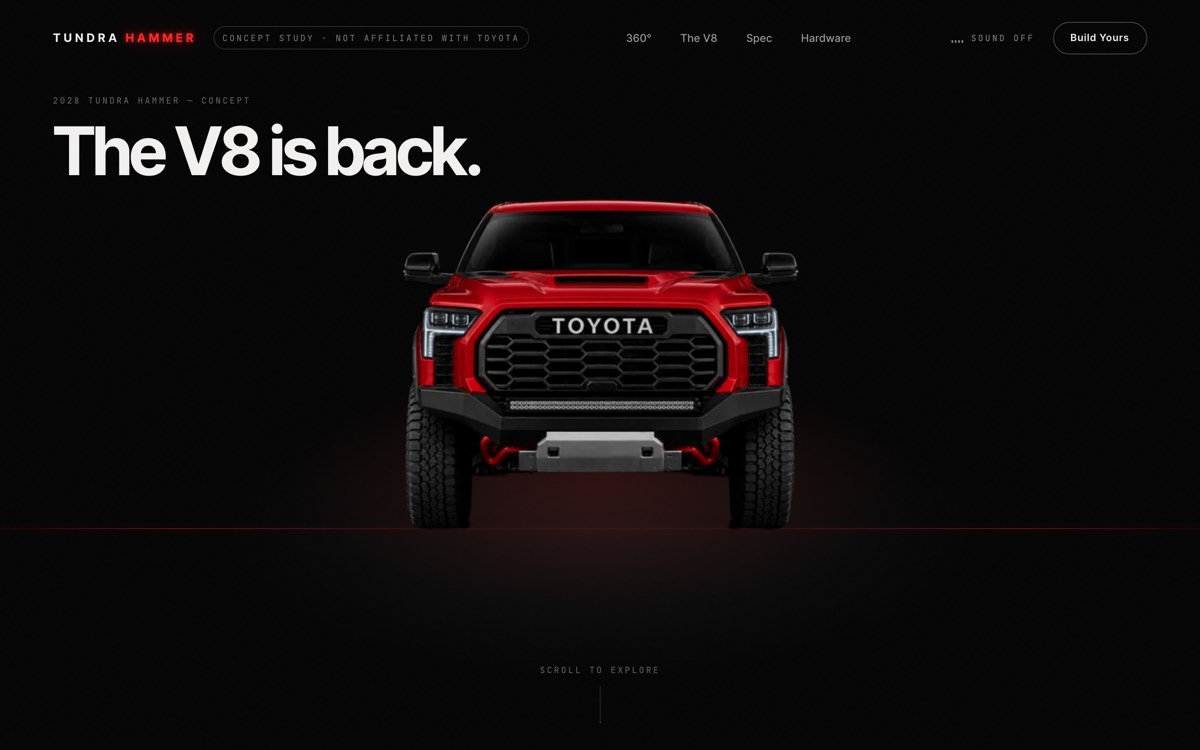
The truck rotates as you scroll, but there is no 3D model. There are ten photographs taken at fixed angles, swapped against scroll position so precisely that the eye reads continuous rotation. Ten images load faster than any model would and look photographic because they are photographs.
The engine note is synthesized in the browser rather than streamed, so it responds to what the visitor is doing instead of playing back a fixed clip. It stays silent until switched on, because a page that makes noise at a stranger is a page they close.
Decisions
Author in degrees, not scroll pixels
The obvious way to drive a rotation is to map scroll offset onto frames. That breaks the moment a viewport size changes, because the same swipe covers a different fraction of the page. Authoring the sequence in degrees of rotation and deriving scroll from that made the whole thing resolution-independent.
Repaint by hue rotation
The configurator changes the truck's color without loading a second set of photographs. Every colorway is the same ten images with a hue transformation applied, which keeps the page weight flat no matter how many colors the configurator offers.
Sound has two states, not one
Audio that is enabled is not the same as audio that is armed. Browsers require a real user gesture before anything can play, so the page has to track both whether the visitor wants sound and whether the browser has granted permission yet. Collapsing those into one flag is how autoplay bugs get shipped.
What shipped
Visit tundra-hammer.pages.dev- Scroll-driven rotation from ten real photographs
- Synthesized engine audio, off until asked for
- A configurator that repaints without new assets
- Labeled on the page as an unaffiliated concept study